Samurai armor and photo shoots
Putting on samurai armor is one of the most photographed things you can do in Kyoto, and the classes go about it in different ways. Some lend kendo armor for training. Others are all about the costume, from a march through the streets in full battle dress to a studio that lights you like a film set. This guide sorts them out and shows how to come home with better pictures.
Two kinds of armor
"Samurai armor" means two quite different things in Kyoto's classes. Kendo armor, called bogu, is modern sports protection. It has a padded helmet with a metal grille (men), a hard chest guard (do), a padded waist guard (tare) and thick gloves (kote). It is built for being hit with a bamboo shinai, and it looks much the same in every kendo hall in Japan.
Battle armor, yoroi, is the costume of the history books, with lacquered plates laced together and a kabuto helmet that often carries a crest. Nobody fights in it today. In the classes it is worn for the look and for the photos, and it is the kind most visitors picture when they book.
Japanese armor in a few lines
Early samurai fought as mounted archers, and their armor was a boxy suit of small lacquered scales laced with silk or leather cord. Over the centuries suits grew lighter and closer-fitting for fighting on foot. After firearms reached Japan in the 1500s, armorers added solid iron plates meant to resist musket fire. During the long peace that followed 1603, armor became a display of rank more than a tool of war, which is why so many fine suits survive. The Wikipedia article on Japanese armor goes further, and the Kyoto National Museum shows armor in rotating displays; samurai Kyoto, places to see fits it into a walk.
An armor march to the Kamo River
Kyoto Samurai Walk, from ~$104, is the class built around yoroi. It runs for 90 minutes from a fifth-floor hall near Kawaramachi-Sanjo, where more than 20 authentic suits line the room. You start by writing your name in kanji on a war fan (gunsen) that you keep. Staff then fit you into full armor and a kabuto, piece by piece.
Matcha with sweets follows among the old suits, then a short video. After a battle cry the group marches out through the streets to the Sanjo riverbank of the Kamo River, where staff take group and solo photos and send them online afterward.
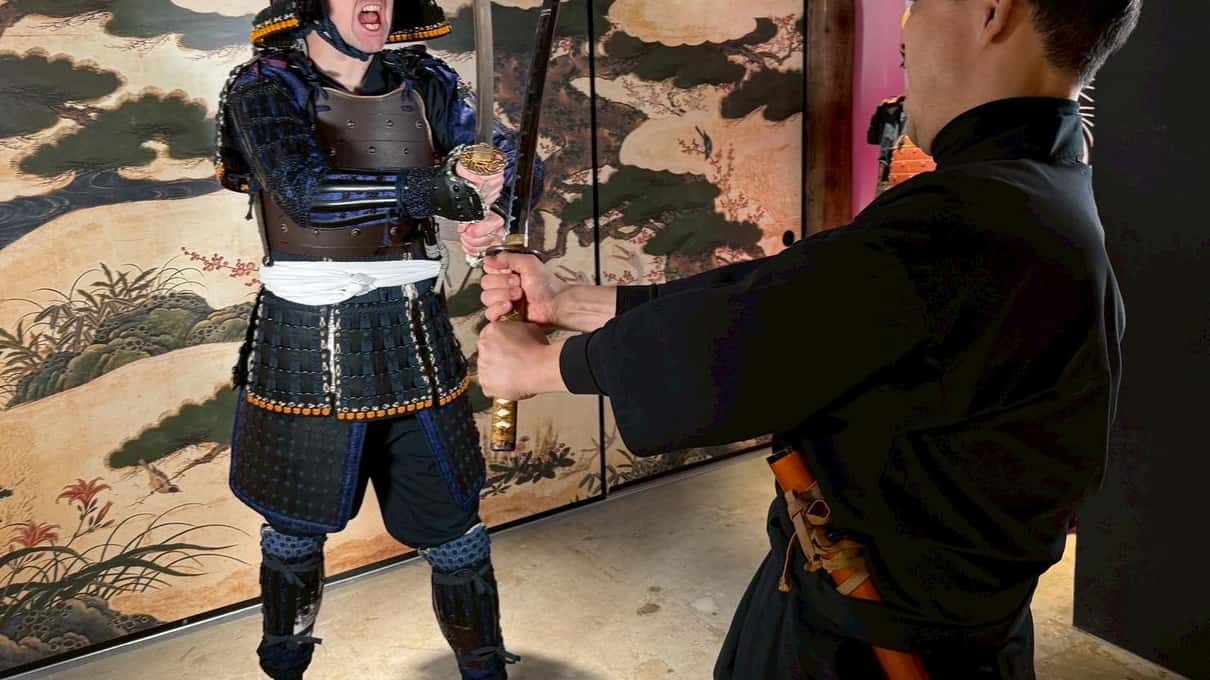
The catch is that it is a costume experience, not a sword lesson. You hold a replica sword for poses and nothing more. The armor is heavy, as the company says in its listing, so it is not for anyone with back problems or for pregnant guests. On Viator it holds a 5.0 rating from more than 450 reviewers, and neither booking site shows a review below three stars.
Into full armor and out to the river
Kyoto Samurai Walk fits you in yoroi and a helmet and walks you to the Kamo River for photos, with matcha among its armor collection first, from ~$104. Free cancellation until 24 hours before, and you can pay later.
A studio shoot in Arashiyama
For pictures that look like film stills, Shogun Studio Japan's armor shoot, from ~$126, works differently. It is a private hour for your group alone, in a second-floor studio three minutes' walk from JR Saga-Arashiyama Station. You wear film-grade armor and pose with props from the rack, a spear and a bow among them. A photographer then lights the scene with studio lamps and fog. The session is private to your group, and the listing accepts children from 4. Its catch is the short track record. With only 14 reviews it is a newer company, and it is a photo session with no class attached, so pair it with a sword lesson elsewhere if you want both.
Kendo armor on the sword classes
At Kendo Experience, from ~$101, you put on a kendo uniform and bogu in an old machiya in Shugakuin, and the instructor takes photos and video of you in it. Some guests say they never wore the full mask shown in the listing photos, so do not count on a picture in the complete helmet. The optional light sparring with staff or your family makes for the liveliest action shots. Kendo, iaido or a sword class? covers the dojos that put you in full bogu for proper strikes.
Photos on the other classes
- Waraku's samurai house class, from ~$114, has staff take photos during the session and email them afterward, so the phone can stay in your bag;
- The Kembu Theater class, from ~$63, ends with a short costume shoot, and its listing photos show guests posing in front of gold screens;
- GOATtrip's temple film class, from ~$125, turns the session into a short fight scene filmed in the grounds of Myokaku-ji. You can shoot on your own camera too, and photos are available to download;
- Iai Dojo Yushinkan, from ~$129, has no photo package, though reviewers mention filming their own practice. Ask before you start.
How to look like a samurai on camera
Most holiday sword photos go wrong in the same way. The guest stands upright with locked knees and stares into the lens, the sword held like an umbrella. A few changes fix that.
- Lower your stance. Set your feet about shoulder width apart, one ahead of the other, and bend the knees. Weight kept low looks ready;
- Point the tip at an opponent. In the basic guard the tip sits at the throat height of an imagined rival, with your hands low in front of your belly. The right hand goes near the guard and the left at the end of the hilt;
- Look past the camera. Fix your eyes on a point beside the lens, as if watching an enemy. Under a kabuto, lift your chin a little so the brim does not hide your eyes;
- Step away from the gold screen. Gold reflects flash. Standing a step or two in front of it softens the glare and keeps your outline sharp;
- Ask for a burst or a short video. A draw or a cut rarely lands in a single frame, and a few seconds of video gives you a still to choose from.
Armor in July heat is hard work, so when to book a samurai class helps you pick a cooler month, and what to wear to a samurai class covers the layer underneath. The suits are heavy for small bodies too. Samurai experiences with kids gives the ages, and what a samurai experience costs sets the armor options against the sword classes.