Dojo etiquette for first-timers
Nobody expects a visitor to know the rules of a Japanese dojo, and every class we compare teaches the basics on the day. Knowing them in advance still helps. You relax sooner, and the instructor can spend the time teaching rather than correcting you.
Why a sword class starts with a bow
In the Japanese martial arts, practice begins and ends with rei, the bow, and the classes for visitors keep that habit even when everything else is shortened. Kendo Experience opens with a talk on etiquette before anyone touches a sword, and the Kembu Theater teaches bowing before the sword work. No instructor expects a first-timer to get it right. What they notice is whether you watch and copy.
The manners are not decoration. Many exist because swords are dangerous, even blunt ones, and a room of beginners swinging wood or metal needs order. The rest come from respect for the place and the teacher, and they cost you nothing.
Bowing in and bowing out
Expect to bow when you step into the training space, at the start of the lesson, to a partner before and after any paired exercise, and when the class ends. A standing bow is a bend from the waist with your eyes lowered and your hands at your sides. The kneeling version starts from seiza, with your hands placed on the floor in front of you. You do not need to count degrees. Bow when the group bows, and hold it as long as they do.
Seiza, and a way out for sore knees
Seiza is the formal kneeling posture, sitting back on your heels with the tops of your feet flat on the tatami. You will kneel this way for bows and for parts of the explanation, sometimes for several minutes. Most visitors find it uncomfortable quickly, and that is normal.
If your knees or ankles object, say so before the class starts rather than in the middle of a bow. Tell the instructor or the interpreter that you have bad knees and ask whether you may sit cross-legged instead. It is a reasonable request, and a quiet word at the start is far more polite than shifting about in silence. Anyone with a back or heart condition should read the listing first, because most of these classes say they are not suitable.
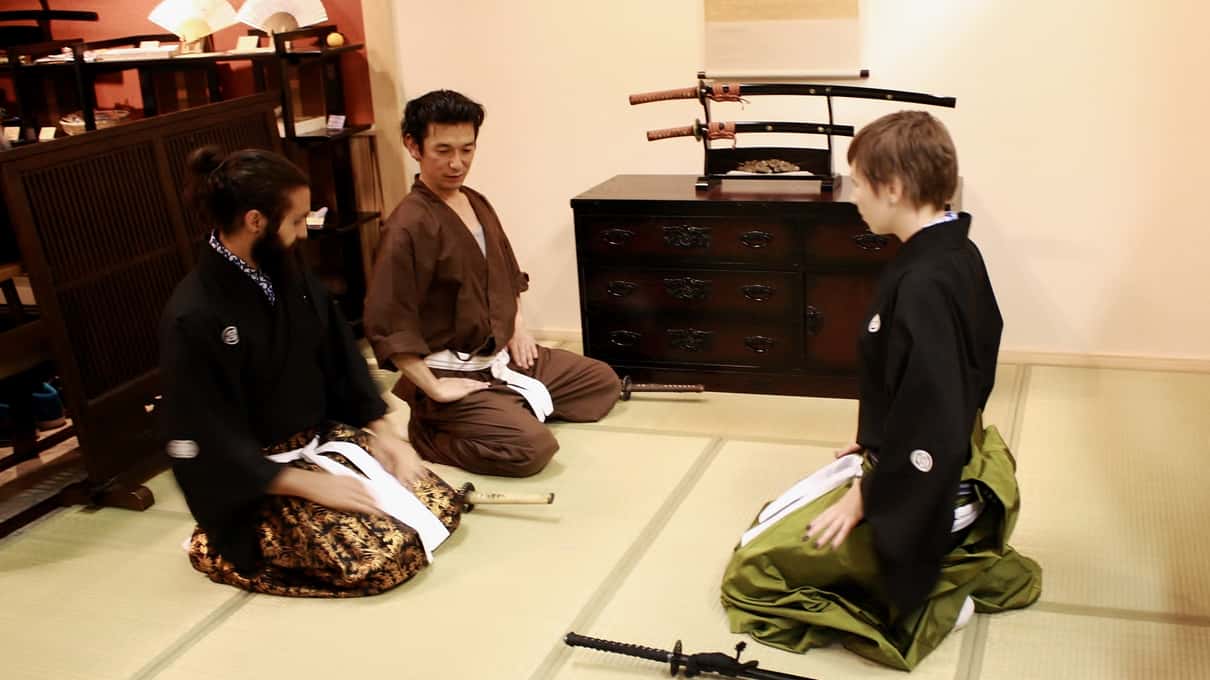
Shoes off and moving through the room
Your shoes stay at the door. Leave them neatly at the entrance, toes pointing out if there is space. When others are practicing, walk around the edge of the room rather than across it. What to wear to a samurai class covers tabi and bare feet in more detail.
Rules around the sword
Treat every sword in the room as if it were sharp. The habit runs through all the classes, whatever is in your hands, from a bamboo shinai to the unsharpened zinc-alloy training katana at Yushinkan.
- Never step over a sword. If one lies on the floor in your path, walk around it. Stepping over a blade is considered rude in any dojo;
- Do not touch a sword until you are told to. That covers the rack on the wall as much as the sword waiting at your place;
- Never draw a blade unless told. Drawing and sheathing are taught as a skill in their own right, and a careless draw is how beginners hurt themselves;
- Take an antique with both hands. Waraku's samurai house class lets guests hold an antique katana that reviewers put at about 600–650 years old. Wait for the instructor to place it in your hands, and hand it back the same way;
- Keep clear of swinging space. Leave more distance than seems necessary between you and the next person, and check behind you before a swing.
Cutting is where the listings disagree. Waraku's class lists a cut at a target with what it calls a real iaito, while the Samurai & Ninja Museum says a Japanese rule now stops operators handing guests a sharp blade, and Yushinkan says mat cutting with a real katana is not currently offered. Real katana, iaito or bamboo? sets out what each class puts in your hands, so read it before you count on a cut.
A working dojo with its own rules
Iai Dojo Yushinkan on Rokkaku-dori teaches drawing and sheathing to groups of up to nine and ends with the headmaster's two-sword demonstration, from ~$129. The dogi and hakama are lent. Ages 12 and up, with free cancellation until 24 hours before.
Commands and the kendo shout
Instructors run the class with short Japanese commands, and you will pick them up within minutes. Commands like hajime, begin, start an exercise, and yame means stop at once, whatever you are doing. When you hear yame, lower the sword and wait. Kendo adds the kiai, a loud shout that goes with each strike. Shy guests find it awkward, but in kendo a silent strike is the odd one out, so let it out. Kendo, iaido or a sword class? explains how the disciplines differ.
Demonstrations are the opposite. When the headmaster at Yushinkan, from ~$129, performs with two swords, or the masters at the Kembu Theater class, from ~$63, perform kenbu, the room stays still. Ask before you film anything. GOATtrip invites you to shoot its fight scene on your own camera, while other classes prefer phones away during demonstrations. Leave other guests out of your pictures unless they agree, and see samurai armor and photo shoots for the classes that photograph you anyway.
Arriving on time, and sober
Being late is the quickest way to start badly. GOATtrip's listing says late arrivals may be refused for its temple film shoot. Waraku's gate opens 15 minutes before each session, and guests are asked to come early to change. Waraku's class has a new home near Nijo Castle, so follow the address in your booking confirmation, not old maps or blog posts. Several venues sit in basements or upper floors that are easy to walk past, Yushinkan behind a blue vending machine and down a spiral staircase among them, so allow time to find the door.
Leave the drink for later. Waraku, Kendo Experience, the Kembu Theater, Kyoto Samurai Walk and GOATtrip all list no alcohol among their rules. Tattoos, which can still keep you out of some hot-spring baths, are not an issue in these classes.
Thanking teachers and interpreters
Some of the people teaching you have spent decades on this. The headmaster at Yushinkan, Seto Yushin, has trained for more than 20 years, and kendo grades run up to 8th dan. Samurai Trip's genuine kendo class, from ~$117, is led by a 7th-dan teacher with more than 40 years of practice. Its catch is the setting, a dojo in Hanazono in west Kyoto reached from JR Hanazono Station, with sessions of up to 30 people.
At Waraku's samurai house class, from ~$114, the sensei teaches through English-speaking assistants. Face the sensei during the explanation before turning to the interpreter. At the end, direct your thanks to the teacher as well as to the person who translated. The same goes for children in the group, and samurai experiences with kids covers the ages each class accepts.
No one expects a tip. Tipping is not customary in Japan, and cash pressed on an instructor tends to cause awkwardness. A bow and a clear arigato gozaimashita at the end of class is the gesture that lands.