Samurai Kyoto: places to see
Kyoto spent more than a thousand years as Japan's imperial capital, and the warlords who fought over the country kept coming back to it. A good share of what they left behind still stands within walking distance of the sword classes. This guide strings the samurai sites into walks and pairs each class with the sights around its door.
Nijo Castle, where the shoguns stayed
Begin at the castle the Tokugawa built to keep watch over the emperor's city. Nijo Castle went up from 1603 for Tokugawa Ieyasu, the year he became shogun, and served as his residence on visits to Kyoto rather than as a fortress built for a siege. Inside the palace the wooden corridors chirp with every step. These are the famous nightingale floors, often described as an alarm against assassins, although the squeak may owe more to nails and clamps shifting as the boards age. The castle also frames the end of the story, since the last shogun is remembered for announcing the return of power to the emperor here in 1867.
Waraku's samurai house class is the nearest sword lesson. Its new venue is near Nijo Castle, and the address on your booking confirmation beats any old map or blog post. The Sword & Zen class, from ~$114, mixes wooden-sword drills with a short zazen sit and lets you hold an antique katana that reviewers date to some 600 years back. Take a morning session and walk to the castle after lunch, and the shoguns' audience halls will mean more than they would on a cold visit.
Mibu and the Shinsengumi
About 20 minutes' walk south of the castle lies Mibu, the quarter where the Shinsengumi were based in the 1860s. The unit served the Shogunate as a police force in its final, violent years, hunting young samurai from rebel domains who wanted the shoguns gone. By most accounts its men drilled in the grounds of Mibu-dera, the local temple, which keeps a small memorial to members of the unit. The temple is modest next to the great halls of Higashiyama and needs less than an hour, but for anyone who has watched a Shinsengumi drama it is the place to start.
Sanjo and the Ikedaya night
The unit's most famous night came in 1864. According to the usual account, Shinsengumi men raided the Ikedaya, an inn near Sanjo where pro-imperial plotters had gathered, and the fight made their name across Japan. The inn is long gone. A marker on Sanjo-dori, a short way west of the bridge over the Kamo River, records where it stood.
Two classes stand within a few minutes of that marker. At Kawaramachi-Sanjo, Kyoto Samurai Walk, from ~$104, fits you in full armor and helmet, then marches the group down to the Sanjo riverbank for photos. It is a dress-up with props and no sword lesson, which our guide to armor and photo shoots explains. Across the bridge, on Sanjo-hanamikoji at the north edge of Gion, Samurai Kembu Theater's sword class, from ~$63, teaches drawing and a short sword-dance routine in a basement studio. From its door, Gion's lanes and Yasaka Shrine are a stroll to the south.
Where Nobunaga fell
Oda Nobunaga, the warlord who set Japan on the road to unification, died at Honno-ji in 1582 when his general Akechi Mitsuhide turned on him. The temple burned that night. Today's Honno-ji stands on a later site on Teramachi-dori near the city hall, a short walk from Kawaramachi-Sanjo, while a stone further west marks roughly where the old one stood.
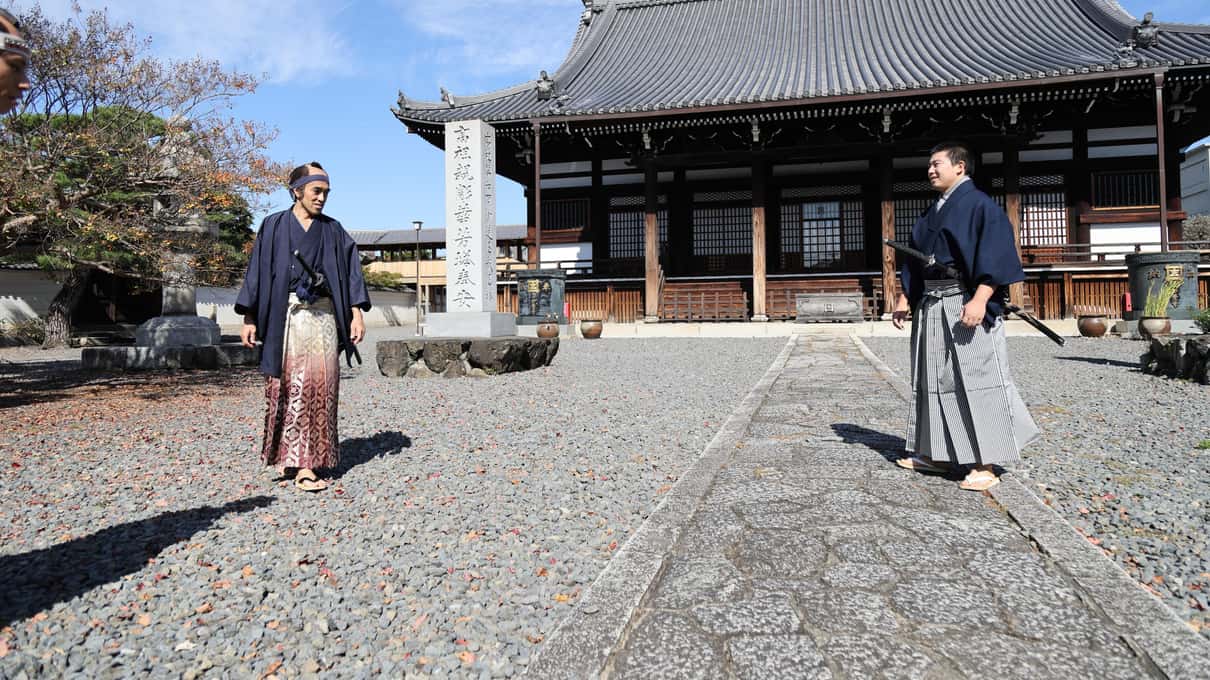
When he came to Kyoto, Nobunaga often lodged at Myokaku-ji, in Kamigyo north of Nijo Castle, and that temple now hosts the liveliest class on the map. GOATtrip's samurai movie-star session, from ~$125, has professional period-drama sword actors teach you a short chanbara fight in the temple dojo, then film it in the grounds. Several temples share the name, so check that your booking says Kamigyo-ku before you set off. Our guide to dojo etiquette covers how to behave in a working temple.
A sword fight where Nobunaga stayed
GOATtrip films your chanbara scene at Myokaku-ji with period-drama actors as your teachers, moving inside the dojo if the weather turns, from ~$125. Sessions take six people at most, and cancellation is free until 24 hours before.
Higashiyama, from the long hall to Ryoma's grave
South in Higashiyama, Sanjusangendo is a temple hall about 390 ft (120 m) long that shelters 1,001 statues of the Buddhist deity Kannon. Along its outer veranda, archers of the Edo period competed to shoot arrows from one end to the other, and an archery event still fills the grounds each January. The Kyoto National Museum stands across the street. Swords and armor are among its rotating displays, so look up what is on show before you go if blades are the point of the visit.
Further north, on the hillside above the Ninenzaka lanes, Ryozen Gokoku Shrine holds the grave of Sakamoto Ryoma. He was a samurai from Tosa who helped bring rival domains together against the shogunate, and he was killed in Kyoto in 1867, before the new government took shape. The climb to the graveyard is steep. Ryoma's other Kyoto landmark is Teradaya in Fushimi, the inn where by tradition he escaped an attack in 1866. The building standing there is widely thought to be a later rebuild, so treat it as a memorial rather than the room itself. A short ride south on the Keihan line gets you there.
A martial arts hall and two sword stops downtown
The Butokuden, near Heian Shrine in Okazaki, was built in 1899 for the Dai Nippon Butoku Kai and ranks among the oldest martial arts halls in Japan. It is still a practice hall, and each spring, in early May, a large kendo gathering brings thousands of practitioners to it. Look from the doorway and keep your voice down if a class is on. Our guide to kendo and iaido explains what you would be watching.
Back in the center, Rokkaku-dori holds two sword stops. Iai Dojo Yushinkan, from ~$129, teaches iaido with an unsharpened training katana to groups of nine at most, from age 12. On the same street, near Nishiki Market, the Samurai & Ninja Museum sells a sword class with a museum ticket, from ~$67. Its drawback is the crowd, since sessions take up to 22 people and reviewers count only 10–15 minutes of hands-on practice. Treat it as a museum visit with a lesson attached, and read which sword each class puts in your hands before you choose.
North-east Kyoto and the Musashi pine
The class at Kendo Experience, from ~$101, meets in an old machiya in Shugakuin, about 15 minutes' walk from Shugakuin Station on the Eizan line and far from the center. Since you are making the trip, add the temples of north-east Kyoto. Shisendo, the hillside retreat of Ishikawa Jozan, a samurai who put down the sword for poetry, lies nearby. Close to it at Ichijoji, a pine marks the spot where, according to tradition, Miyamoto Musashi fought the Yoshioka school.
Stringing the sites into a day
- A west-side day. A morning class near Nijo Castle, the castle after lunch, then Mibu-dera in the late afternoon;
- A river day. Armor at Kawaramachi-Sanjo or kenbu at Sanjo-hanamikoji, then the Ikedaya marker and today's Honno-ji on Teramachi;
- A Higashiyama day. Sanjusangendo and the National Museum in the morning, then north on foot toward Ryozen Gokoku Shrine and Gion;
- A north-east day. Kendo in Shugakuin, with Shisendo and the Ichijoji pine before or after.
Taxis between these clusters save energy in summer, when crossing town on foot in the heat wears people out. When to book a samurai class covers the hot months, and what a samurai experience costs adds the fares on top. If you are still choosing the city, read Kyoto or Tokyo for a samurai class first.